

Online calculator for the surface area of the side of a cylinder
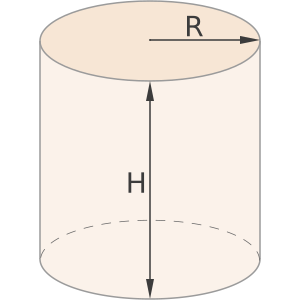
Radius (R)
Height (H)
Keep decimals
Calculation result
The Cylinder Lateral Surface Area Calculator is a professional online mathematical tool specifically designed to calculate the lateral surface area of a cylinder (excluding the top and bottom bases). Simply input the base radius and height of the cylinder to quickly obtain accurate lateral surface area calculation results. This tool is suitable for students, teachers, engineers, and anyone who needs to calculate the lateral surface area of a cylinder.
The calculation of the lateral surface area of a cylinder is based on a simple yet precise mathematical formula:
Lateral Surface Area = 2 × π × r × h
Where:
r represents the radius of the cylinder's base
h represents the height of the cylinder
π is the mathematical constant pi, approximately equal to 3.14159
The lateral surface of a cylinder can be imagined as an "unfolded" rectangle. One side of this rectangle equals the height of the cylinder (h), while the other side equals the circumference of the base circle (2πr). Therefore, the lateral surface area of the cylinder is the area of this rectangle, which is the height multiplied by the base circumference:
Lateral Surface Area = Height × Base Circumference = h × (2πr) = 2πrh
Calculation Example
Assume a cylinder with base radius r = 5 cm and height h = 10 cm:
Calculate base circumference: 2 × 3.1416 × 5 ≈ 31.416 cm
Calculate lateral surface area: 31.416 × 10 ≈ 314.16 cm²
Or use the formula directly: 2 × 3.1416 × 5 × 10 ≈ 314.16 cm²
Enter the radius value of the cylinder's base in the "Base Radius" input field
Enter the height value of the cylinder in the "Cylinder Height" input field
Click the "Calculate Lateral Surface Area" button
View the calculation results, including the numerical result and the formula used
1. What is the difference between lateral surface area and total surface area of a cylinder?
The lateral surface area only includes the curved surface of the cylinder, excluding the areas of the top and bottom bases. The total surface area includes both the lateral surface area and the total area of the two bases. If you only need to calculate material usage or coating area for the side of the cylinder, using the lateral surface area calculation is more appropriate.
2. Why use radius instead of diameter?
The formula uses radius because it directly relates to the circumference formula of a circle (circumference = 2πr). Although diameter (d = 2r) can be used for calculation, using radius is more direct and common.
3. What units should be used for input values?
This tool does not restrict the units of input values, but please ensure that both radius and height use the same units (such as both in centimeters or both in meters). The calculation results will use the square of the corresponding units (such as cm² or m²).
4. Can I calculate the lateral surface area of a non-vertical cylinder?
Yes. Whether the cylinder is vertical or inclined, as long as you know its height (or generatrix length) and base radius, you can use the same formula to calculate the lateral surface area. For oblique cylinders, the height should be replaced with the actual length of the generatrix.
5. Is this calculator suitable for hollow cylinders?
It is suitable for calculating the external surface area of hollow cylinders (tubular structures), but note that you should input the outer radius rather than the inner radius. If you want to calculate the internal surface area of a hollow cylinder, you need to use the inner radius as the input value.
6. What is the precision of the mathematical constant π?
This tool uses the built-in JavaScript Math.PI value, which has a precision of approximately 15 decimal places (3.141592653589793), far exceeding the precision requirements of general applications.
Cylinder lateral surface area calculation has wide applications in multiple fields:
Construction engineering: Calculating the surface area of cylindrical columns or pipes
Manufacturing: Determining the material quantity required for cylindrical containers
Packaging industry: Calculating the label area of cylindrical packaging
Education: Teaching assistance for mathematics and geometry
Daily applications: Calculating paint or packaging requirements for cylindrical objects
Please ensure all input values are positive numbers, as negative values will cause calculation errors
Although the tool accepts decimal inputs, overly precise measurement values may not be necessary in practical applications
For extremely precise scientific or engineering calculations, factors such as measurement errors and material characteristics may need to be considered
This tool provides a simple and quick method for calculating the lateral surface area of a cylinder, suitable for most daily applications and educational purposes. For highly precise calculations in professional fields, it is recommended to combine with specific industry standards and actual requirements.


